

On average, it takes 11.4 months to resolve a personal injury claim arising from a car crash, according to data published by Alabama-based injury firm Baxley Maniscalco. Some cases settle in weeks. Others stretch past two years. If you are dealing with mounting medical bills and lost wages after an accident in Alabama, you need a clear picture of what happens next and how long each step actually takes. This guide breaks down the entire Alabama personal injury settlement process into seven stages — with realistic time estimates for each — so you know exactly what to expect from accident to payout.
Why Alabama Settlements Are Different: 3 Laws That Shape Your Timeline
Before walking through the timeline, you need to understand three Alabama-specific laws that directly affect how long your case will take and how much you can recover.

Alabama is an at-fault state. The person who caused the accident is responsible for paying damages. This is different from no-fault states where each driver’s own insurance covers their losses. According to FindLaw’s Alabama settlement guide, Alabama law requires every driver to carry minimum liability coverage of $25,000 per person and $50,000 per accident for bodily injury.
Alabama follows pure contributory negligence. This is the strictest fault standard in the country. If you are found even 1% at fault for the accident, you may be completely barred from recovering any compensation. Only four other jurisdictions — Maryland, Virginia, North Carolina, and Washington D.C. — still follow this rule. Insurance companies in Alabama routinely use contributory negligence to deny valid claims, which can extend your timeline significantly as your attorney works to prove you bear zero fault. (For a deeper explanation, read our guide on contributory negligence in Alabama.)
You have a two-year statute of limitations. Under Alabama Code § 6-2-38, you generally have two years from the date of your injury to file a personal injury lawsuit. For wrongful death cases, the two-year clock starts from the date of death. Miss this deadline, and the court will almost certainly dismiss your case — regardless of how strong your evidence is.
These three factors create a legal environment where preparation, speed, and precision matter more than in almost any other state. That is why working with an experienced trial attorney from the start can dramatically affect both your timeline and your outcome.
The 7 Stages of an Alabama Personal Injury Settlement
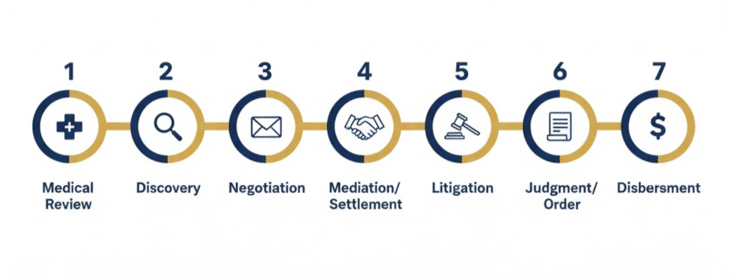
Stage 1: Medical Treatment and Recovery (Weeks to Months)
Estimated timeline: Ongoing — from the day of the accident until you reach Maximum Medical Improvement (MMI)
Your health comes first. But from a legal standpoint, your medical treatment also creates the foundational evidence for your entire case. Every doctor visit, prescription, imaging scan, and therapy session generates records that document the severity and cost of your injuries.
The critical concept here is Maximum Medical Improvement, or MMI. This is the point at which your doctor determines that your condition has stabilized and is unlikely to improve significantly with additional treatment. Your attorney will generally advise against settling your case before reaching MMI because you cannot accurately calculate the full value of your claim — including future medical costs — until you know the complete scope of your injuries.
For soft tissue injuries like whiplash or minor sprains, MMI might arrive in a few weeks or months. For catastrophic injuries involving surgeries, spinal damage, or traumatic brain injury, MMI can take a year or longer.
What Strickland Law Group does during this stage: We begin investigating your case immediately — securing accident scene evidence, obtaining police reports, identifying witnesses, and preserving surveillance or dashcam footage before it is overwritten. This parallel work means we are building your case while you are focused on healing.
Stage 2: Investigation and Evidence Collection (1–3 Months)
Estimated timeline: 4–12 weeks, often running concurrently with medical treatment
A strong Alabama personal injury case is built on evidence that proves two things: the defendant was 100% at fault, and your injuries are directly caused by the accident. In a contributory negligence state, there is no room for ambiguity.
During this phase, your attorney will gather:
- The official police accident report
- Photographs and video from the accident scene
- Witness statements and contact information
- Medical records and billing statements
- Employment records documenting lost wages
- Any available dashcam, traffic camera, or surveillance footage
- Expert opinions, including accident reconstruction if needed
For auto accident cases involving commercial trucks, this phase may also include obtaining the truck driver’s logbooks, electronic logging device (ELD) data, the trucking company’s maintenance records, and the driver’s employment and training history. These records are subject to federal retention requirements and must be preserved quickly.
Stage 3: Calculating Your Damages (2–4 Weeks)
Estimated timeline: 2–4 weeks after reaching MMI
Before your attorney sends a demand letter, they need an accurate calculation of every dollar your case is worth. Alabama law allows you to pursue both economic and non-economic damages.
Economic damages are quantifiable financial losses:
- Past and current medical bills
- Projected future medical expenses
- Lost wages and income
- Loss of future earning capacity
- Out-of-pocket expenses (transportation to appointments, medical equipment, home modifications)
Non-economic damages compensate for intangible losses:
- Physical pain and suffering
- Emotional distress
- Loss of enjoyment of life
- Loss of consortium (impact on your relationship with your spouse)
Alabama does not cap compensatory damages in most personal injury cases, which means there is no statutory limit on what you can recover for your injuries. However, punitive damages — which punish especially reckless behavior — are subject to statutory caps.
Your attorney may consult medical experts, vocational specialists, and economists to project future costs accurately. You can also explore our personal injury claim settlement calculator for a preliminary estimate.
Stage 4: The Demand Letter (1–2 Weeks to Draft; 2–6 Weeks for Response)
Estimated timeline: 3–8 weeks total
The demand letter is the formal opening shot of settlement negotiations. It is a detailed legal document sent to the at-fault party’s insurance company that includes:
- A clear narrative of how the accident occurred and why their insured is liable
- A summary of all injuries and medical treatment
- Documentation of all economic and non-economic damages
- A specific dollar amount you are willing to accept to settle the claim
Alabama insurance law requires companies to acknowledge a claim within 15 days and make a decision on the claim within 30 days of receiving completed proof of loss forms. After approving a claim, the insurer has an additional 30 days to issue payment. In total, the statutory framework allows up to 75 days for first-party claims.
In practice, however, insurance company responses to demand letters vary widely. Insurers with clear liability may respond with an initial offer within 20–30 days. Contested or complex claims — particularly those where contributory negligence is alleged — may take 60–90 days or longer for a substantive response.
The most common responses are:
- An initial lowball settlement offer designed to test whether you will settle quickly
- A request for additional documentation (medical records, prior medical history, employment verification)
- A full or partial denial of the claim
Michael Strickland, who has represented injury victims since 1994, emphasizes that the first offer from an insurance company is almost never the final number. “Insurance companies make their money by paying out less than claims are worth. The first offer is a starting point, not a finish line.”
Stage 5: Settlement Negotiations (1–6 Months)
Estimated timeline: 4 weeks to 6+ months
This is typically the longest pre-litigation phase of the process. Negotiations involve multiple rounds of offers and counteroffers between your attorney and the insurance company.
According to data from Collins Law, LLC, a Birmingham-based personal injury firm, the negotiation process averages three to six months but can extend significantly for high-value or complex claims. Most Alabama personal injury settlements conclude within 6–18 months after the claim process begins.
Several factors influence how long negotiations take:
- Injury severity: Catastrophic injuries with large medical bills and long-term care needs require more documentation and justification, which extends negotiations.
- Liability disputes: If the insurance company alleges contributory negligence, your attorney must present evidence eliminating any suggestion of shared fault — a process that takes time and often requires expert analysis.
- Number of parties involved: Multi-vehicle accidents or claims against multiple defendants (such as a trucking company, the driver, and a maintenance contractor) require coordinated negotiations with multiple insurers.
- Policy limits: When your damages exceed the at-fault party’s insurance limits, your attorney may need to identify additional coverage sources, including umbrella policies or your own uninsured/underinsured motorist (UM/UIM) coverage.
During this phase, Strickland Law Group prepares every case as if it is going to trial. This trial-ready posture is not a bluff — it is what makes insurance companies negotiate seriously. With over $1 billion in recovered settlements and jury verdicts, our track record sends a clear message to insurers that we will not accept lowball offers.
Stage 6: Litigation (If Necessary) (6 Months to 2+ Years)
Estimated timeline: 6 months to 2+ years if a lawsuit is filed
If negotiations fail to produce a fair settlement, your attorney may recommend filing a lawsuit. Filing does not mean your case will go to trial — the vast majority of lawsuits still settle before reaching a courtroom. But the formal litigation process adds structure, deadlines, and legal tools that often motivate insurance companies to negotiate more seriously.
Key phases of litigation include:
- Filing the complaint: Your attorney files a formal lawsuit in the appropriate Alabama court.
- Discovery: Both sides exchange evidence, take depositions (sworn testimony), and obtain expert opinions. Discovery is often the longest phase of litigation.
- Mediation: Many Alabama courts require or encourage mediation — a structured negotiation session with a neutral third party. A significant number of cases settle during or shortly after mediation.
- Trial: If all settlement efforts fail, the case goes before a judge or jury. The average personal injury trial in Alabama can take one year or longer to resolve after filing, according to Salter Ferguson, a Birmingham-based litigation firm.
Jury Verdict Research conducted a study of Alabama jury trials and found that the average personal injury verdict was $309,062. However, high verdicts can significantly stretch that average. Individual outcomes depend entirely on the facts and evidence of each case.
Michael Strickland has personally tried more than 100 cases to verdict during his career. This courtroom experience is critical, because insurance companies track which attorneys actually go to trial — and they offer higher settlements to firms with a proven record of winning in front of juries.
Stage 7: Receiving Your Settlement Check (2–6 Weeks After Agreement)
Estimated timeline: 2–6 weeks after signing the settlement agreement
Reaching a settlement agreement is a major milestone, but it is not the final step. Several administrative tasks must be completed before the money is in your hands.
After both parties agree on the settlement amount:
- You sign a release form. This document releases the defendant from further liability in exchange for the agreed-upon payment.
- The insurance company issues a check. Alabama law requires insurers to release funds within 30 days of signing. In practice, most checks arrive within two to three weeks.
- Your attorney deposits the check into a trust account. This is a required step that ensures all outstanding obligations are satisfied before you receive your portion.
- Liens and obligations are paid. Medical liens, health insurance subrogation claims, Medicare or Medicaid liens, and any outstanding medical bills are resolved from the settlement funds.
- Attorney fees and case costs are deducted. Most personal injury attorneys, including Strickland Law Group, work on a contingency fee basis — meaning you pay nothing unless we win. The contingency fee (typically 33%–40%) and case expenses are deducted from the settlement.
- You receive your net settlement check. After all deductions, your attorney issues the remaining funds to you with a detailed accounting of all disbursements.
From the day you sign the release to receiving your final check, expect approximately four to six weeks.
How to Avoid Common Delays
Based on over 30 years of handling Alabama personal injury cases, Strickland Law Group has identified the most common mistakes that slow down settlements:
- Settling before reaching MMI. Accepting an early offer before you know the full extent of your injuries almost always means leaving money on the table. Once you sign a release, you cannot go back for additional compensation — even if your injuries turn out to be far worse than initially expected.
- Gaps in medical treatment. Missing appointments or going weeks without treatment gives insurance companies ammunition to argue your injuries are not as serious as claimed.
- Giving recorded statements without an attorney. Insurance adjusters are trained to extract statements that can be used to allege contributory negligence. Never provide a statement without your attorney present.
- Posting on social media. Insurers actively monitor your social media. Photos of you at events, exercising, or traveling can be used to contradict your claimed injuries.
- Waiting too long to hire an attorney. Evidence disappears. Surveillance footage gets overwritten. Witnesses forget details. The sooner you engage legal counsel, the stronger your case.
Conclusion
The average Alabama personal injury claim takes 6–18 months to resolve, with some cases settling faster and complex litigation extending past two years. The 11.4-month average for car crash claims reflects this range. Every stage — from medical treatment to demand letters to negotiations to receiving your check — follows a predictable sequence, but the timeline depends on injury severity, liability clarity, and whether insurance companies negotiate in good faith.
Since 1994, Strickland Law Group has recovered over $1 billion in settlements and verdicts for clients across the country. We understand the Alabama-specific factors — contributory negligence, the at-fault system, the two-year statute of limitations — that make these cases uniquely challenging. And we prepare every case for trial so insurance companies know we will not accept less than you deserve.
If you have been injured in an accident in Alabama and want to understand your timeline and options, call Strickland Law Group at 334-269-3230 for a free, no-obligation consultation. Available 24/7, with offices in Alabama, Georgia, Colorado, North Carolina, Vermont, and Washington D.C.
FAQ
Q: How long does a personal injury settlement take in Alabama?
A: Most Alabama settlements conclude within 6–18 months. Simple cases with clear liability and minor injuries may resolve in 3–6 months. Complex cases involving serious injuries or litigation can take 1–2+ years.
Q: How long does an insurance company have to settle a claim in Alabama?
A: Alabama law requires insurers to acknowledge claims within 15 days, decide on claims within 30 days of receiving proof of loss, and pay approved claims within 30 days — totaling 75 days for first-party claims.
Q: Should I accept the first settlement offer from the insurance company?
A: Almost never. Initial offers are typically lowball figures designed to close claims cheaply. Claims that resolve within the first month often receive nothing for pain and suffering. An attorney can negotiate for the full value of your case.
Q: What is Maximum Medical Improvement (MMI) and why does it matter for my settlement?
A: MMI is when your doctor determines your condition has stabilized. Settling before MMI means you cannot account for future medical costs, often resulting in compensation far below what your case is worth.
Q: Does Alabama have a deadline to file a personal injury lawsuit?
A: Yes. Alabama Code § 6-2-38 sets a two-year statute of limitations for most personal injury cases, starting from the date of injury. Wrongful death claims also have a two-year deadline from the date of death.
SOCIAL MEDIA COPY
- The avg Alabama injury claim takes 11.4 months. Here’s what happens at each stage — and how to avoid delays. (108 chars)
- Did you know Alabama insurers have just 75 days to settle first-party claims? Know your rights after an accident. (114 chars)
- 1% fault = $0 in Alabama. That’s why your settlement timeline depends on the attorney fighting for you. (104 chars)
This article references publicly available information from Strickland Law Group, FindLaw, Collins Law LLC, Baxley Maniscalco, Salter Ferguson, Burge & Burge PC, Jury Verdict Research, and WalletHub, including official documentation, published legal analyses, and publicly reported case data dated 2023–2026. All timelines and legal principles described reflect Alabama law as of February 2026. Settlement timelines vary based on injury severity, liability, insurance cooperation, and whether litigation is required. This article is for informational purposes only and does not constitute legal advice. For guidance on your specific situation, contact Strickland Law Group at 334-269-3230 for a free consultation.