

Within days of your accident, a phone will ring. The voice on the other end will be warm, concerned, and professional. They will introduce themselves as a claims adjuster and explain that they just need to “get your side of the story” so they can “process your claim quickly.” They are not calling to help you. They are calling to build a case against you. In most states, the adjuster’s goal is to minimize the payout. In Alabama, the goal is often to eliminate it entirely. Alabama’s contributory negligence rule means that if the insurer can establish that you were even 1% at fault for the accident, your claim is worth exactly zero. Every question the adjuster asks, every document they request, and every delay they impose is designed to find that 1% — or to pressure you into accepting a fraction of what your claim is worth before you understand the full picture. This article identifies the six most common tactics and gives you the exact playbook for defeating each one.
Why Alabama’s Contributory Negligence Rule Changes Everything About Insurance Tactics
Before examining specific tactics, you need to understand why adjusters operate differently in Alabama than in virtually every other state.
In the 45 states that follow comparative negligence, an insurer’s best-case scenario when the plaintiff is slightly at fault is a reduced payout. If you are 10% at fault in Texas, you still recover 90% of your damages. The adjuster’s incentive is to argue about percentages.
In Alabama, the calculus is binary. Zero percent fault means full recovery. One percent fault means zero recovery. This gives Alabama adjusters a uniquely powerful weapon: they do not need to prove you were mostly at fault, or even significantly at fault. They just need one crack — one offhand comment, one minor traffic violation, one social media post — to argue that you share some fraction of responsibility.
As we detailed in our contributory negligence guide, exceptions exist for wanton conduct, last clear chance, children under 14, and product liability. But the general rule creates an environment where adjusters are more aggressive, more persistent, and more strategic in Alabama than in almost any other state. Understanding their tactics is not optional — it is the foundation of protecting your claim.
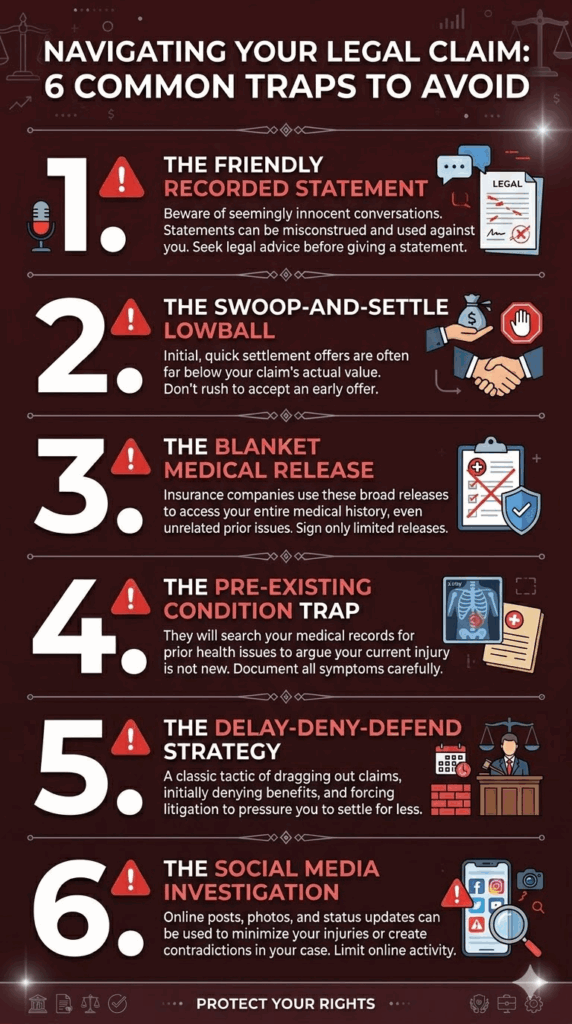
Tactic 1: The Friendly Recorded Statement
How it works: Within days of your accident, the adjuster calls and asks you to “describe what happened in your own words.” They explain that a recorded statement is “standard procedure” and will “help process your claim faster.” The conversation feels casual, conversational, even sympathetic.
What they are really doing: The adjuster is conducting a carefully structured interrogation. Every question is designed to extract a statement that can later be used to establish contributory negligence or minimize your injuries.
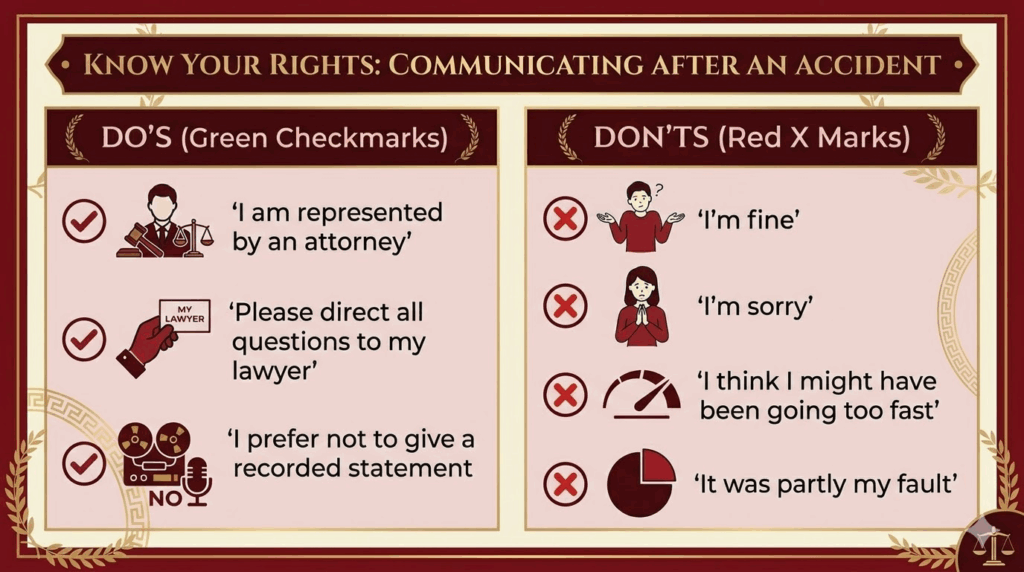
They will ask open-ended questions like “Can you walk me through exactly what happened?” looking for inconsistencies between your account and the police report. They will ask “How fast were you going?” hoping for any estimate above the speed limit. They will ask “Were you on your phone?” or “Did you see the other vehicle before the impact?” looking for even a hint that you were not paying full attention. And they will ask “How are you feeling today?” — because if you reflexively answer “I’m fine” or “I’m doing okay,” that phrase goes into the claim file as evidence that your injuries are not serious.
How to beat it: You are not legally required to give a recorded statement to the other driver’s insurance company. Period. Politely decline and say: “I have retained an attorney. Please direct all communications to my lawyer.” Then contact an attorney before any further conversation. As we explain in our car accident checklist, this is the single most important piece of advice for any Alabama accident victim.
Tactic 2: The Swoop-and-Settle Lowball Offer
How it works: Within one to two weeks of the accident — sometimes within days — the adjuster calls with a settlement offer. It sounds generous in the moment: “We’ve reviewed the initial report, and we’re prepared to offer you $3,000 to resolve your claim today. We can have a check in the mail this afternoon.”
What they are really doing: The adjuster is betting that you do not yet know the full extent of your injuries. Many serious conditions — herniated discs, traumatic brain injuries, torn ligaments, internal damage — do not present full symptoms for days or weeks after an accident. The $3,000 offer is made before you know whether you need surgery, months of physical therapy, or lifelong treatment.
When you accept a settlement, you sign a release of all claims. That release is permanent and legally binding. If your “sore back” turns out to be a herniated disc requiring $80,000 in surgery, you cannot go back and ask for more money. The insurance company knows this. The early offer is not generosity — it is a bet that your injuries are worth far more than what they are paying.
How to beat it: Never accept a settlement offer before you have reached maximum medical improvement (MMI) — the point at which your doctor confirms that your condition has stabilized and no further improvement is expected. This is a critical milestone in the settlement timeline that determines when your attorney can accurately calculate the full value of your claim. An experienced attorney will not let you settle early.
Tactic 3: The Blanket Medical Release
How it works: The adjuster sends you a medical authorization form and explains that they need your medical records “to verify your injuries and process your claim.” The form looks standard and bureaucratic.
What they are really doing: The form is almost always a blanket release that gives the insurance company access to your entire medical history — not just records related to the accident. They want to see every doctor visit, every complaint, every prescription for the past five, ten, or twenty years.
Why? Because they are looking for pre-existing conditions. If you visited a chiropractor three years ago for back stiffness, they will argue that your current spinal injury is a pre-existing condition — not an accident-related injury. If you were ever prescribed anxiety medication, they will argue that your emotional distress is a pre-existing mental health issue. Their goal is to attribute your current pain to anything other than the negligence of their insured driver.
How to beat it: Never sign a blanket medical release. Your attorney can provide a limited authorization that covers only medical records related to the accident and the specific injuries claimed. This prevents the insurer from conducting a fishing expedition through your entire medical history.
Tactic 4: The Pre-Existing Condition Trap
How it works: Even without a blanket release, adjusters will scrutinize every medical record they do receive. They will look for any mention of prior injuries, past complaints, or pre-existing conditions — no matter how old, how minor, or how unrelated.
What they are really doing: Alabama insurance adjusters use pre-existing conditions in two ways. First, they argue that your current injuries were not caused by the accident but by a prior condition. Second, they argue that your prior condition made you more fragile — and that if you were not already compromised, the accident would not have caused such severe injuries. Either argument gives them a basis to deny the claim or dramatically reduce the payout.
This tactic intersects directly with contributory negligence. If the adjuster can show that you failed to disclose a relevant medical condition to your doctor, or that you were not managing a known condition properly, they may argue that your own medical negligence contributed to the severity of your injuries — triggering the 1% fault bar.
How to beat it: Be completely honest with your treating physicians about your medical history. Do not hide prior injuries — instead, have your doctor clearly document how the current injury differs from any prior condition, what new symptoms appeared after the accident, and how the accident caused or aggravated the current problem. Your attorney can work with medical experts to establish clear causation that defeats the pre-existing condition defense.
Tactic 5: The Delay-Deny-Defend Strategy
How it works: Instead of responding promptly, the adjuster goes quiet. Calls go unreturned for days or weeks. Document requests are repeated. The file is “transferred to a different department.” Weeks turn into months with no progress. Then, when you are exhausted and financially desperate, the adjuster reappears with a lowball offer — knowing you are now more likely to accept it just to end the ordeal.
What they are really doing: This is a deliberate strategy known in the insurance industry as “delay, deny, defend.” The insurer knows that time is on their side. As your medical bills accumulate, your savings deplete, and your frustration builds, your willingness to accept a lower settlement increases. They are manufacturing financial pressure to force you into an unfavorable settlement.
In extreme cases, the adjuster may deliberately stall past critical deadlines. Alabama Insurance Code Chapter 482-1-125 requires insurers to acknowledge claims within 15 days and accept or deny them within 30 days of receiving proof of loss. But enforcement of these timelines often depends on whether you have an attorney holding the insurer accountable. Without legal representation, delays can stretch for months.
If the delay crosses the line from inefficiency to intentional misconduct, Alabama law provides a remedy: a bad faith insurance lawsuit. As we explained in our disaster claims guide, Alabama recognizes insurance bad faith as a personal injury tort — meaning successful plaintiffs can recover compensatory damages, mental anguish damages, and punitive damages up to three times compensatory damages.
How to beat it: An attorney eliminates the delay tactic immediately. When a law firm with a known trial record sends a demand letter, the insurance company knows that continued delay will result in a lawsuit — not a frustrated victim giving up. Strickland Law Group’s founding partner Michael Strickland has tried more than 100 cases since 1994. Insurance companies know which firms go to trial and which do not.
Tactic 6: The Social Media Investigation
How it works: After your accident, you post a photo at a family birthday party. You check in at a restaurant. A friend tags you in a video at a neighborhood cookout. You write “feeling grateful to be alive” on your Facebook page.
What they are really doing: Insurance companies actively monitor claimants’ social media accounts. They look for any post, photo, video, check-in, or comment that can be used to argue that your injuries are not as severe as claimed or that you are physically capable of activities you say you cannot perform.
A photo of you smiling at a family event becomes “evidence” that you are not in pain. A check-in at a park becomes “evidence” that your mobility is not limited. The phrase “feeling grateful” becomes “evidence” that you are not suffering. These interpretations are often wildly unfair — but they are effective in settlement negotiations and devastating in front of a jury.
How to beat it: The safest approach: do not post anything on social media from the date of the accident until your claim is fully resolved. Set all accounts to private. Ask friends and family not to tag you in posts. Do not discuss the accident, your injuries, your medical treatment, or your legal case online in any form. This advice applies across every type of claim — auto accidents, truck accidents, medical malpractice, and wrongful death cases.
The One Thing That Defeats Every Tactic: Attorney Representation
Every tactic in the adjuster’s playbook relies on one assumption: that you are handling the claim alone. Unrepresented claimants give recorded statements. They accept lowball offers. They sign blanket releases. They post on social media. They give up after months of delay. And in Alabama’s contributory negligence system, they say something — anything — that establishes 1% fault.
An experienced personal injury attorney eliminates every one of these vulnerabilities:
- Takes over all communication immediately. The adjuster never speaks to you again. Every word goes through the attorney, who understands exactly what can and cannot be said.
- Preserves evidence before it disappears. Medical records, accident scene evidence, dashcam footage, ELD data in truck cases, and witness statements are secured within days.
- Calculates the full value of the claim. Not just current medical bills — but future treatment costs, lost earning capacity, pain and suffering, and in wrongful death cases, uncapped punitive damages.
- Builds a case that shuts down contributory negligence. Through accident reconstruction, witness testimony, dashcam evidence, and expert analysis, the attorney establishes that the defendant was entirely at fault.
- Creates the credible threat of trial. Insurance companies know the difference between a demand letter from a firm that settles every case and a demand letter from a firm whose founding partner has tried over 100 cases. The settlement value of your claim changes dramatically when the insurer knows a courtroom fight is a real possibility.
Strickland Law Group has recovered over $1 billion in settlements and jury verdicts across all practice areas. We handle auto accidents, truck accidents, medical malpractice, wrongful death, and disaster claims — and we take over insurance communications from day one.
Call 334-269-3230 for a free consultation — available 24 hours a day, 7 days a week. You pay nothing unless we win.
Conclusion
The insurance adjuster who calls after your accident is not your advocate. They are a trained professional whose performance is measured by how little their company pays out. In Alabama — where 1% fault eliminates your entire claim — their tactics are more dangerous than in any other state.
Do not give a recorded statement. Do not accept an early settlement. Do not sign a blanket medical release. Do not post on social media. And do not try to negotiate alone in a state where the rules are rigged against unrepresented claimants.
The adjuster’s greatest advantage is the information gap between what they know and what you know. This article closes that gap. But reading about tactics is not the same as having an attorney who defeats them every day. Call Strickland Law Group at 334-269-3230. The consultation is free. You pay nothing unless we recover compensation for you.
FAQ
Q: Am I required to give a recorded statement to the other driver’s insurance company in Alabama?
A: No. You have no legal obligation to provide a recorded statement to the at-fault driver’s insurer. Politely decline and direct all communications to your attorney. Anything you say can be used to establish contributory negligence and deny your entire claim.
Q: How do I know if an insurance settlement offer is fair?
A: You cannot evaluate a settlement offer until you have reached maximum medical improvement (MMI) and know the full extent of your injuries, future treatment needs, and lost earning capacity. An experienced attorney can calculate the true value of your claim and negotiate accordingly.
Q: Can the insurance company access my entire medical history?
A: Only if you sign a blanket medical authorization. Never sign one without attorney review. Your lawyer can provide a limited release covering only records related to the accident and the specific injuries claimed, preventing a fishing expedition through your medical past.
Q: What is insurance bad faith in Alabama?
A: When an insurer denies or delays a valid claim without legitimate justification, Alabama law allows a bad faith lawsuit. Successful plaintiffs can recover compensatory damages, mental anguish damages, and punitive damages. The statute of limitations is two years from the wrongful action.
Q: How does Alabama’s contributory negligence rule affect insurance negotiations?
A: It gives adjusters a uniquely powerful weapon. In most states, partial fault reduces your payout. In Alabama, 1% fault eliminates it. This means adjusters aggressively search for any evidence — a casual apology, a minor traffic violation, a social media post — to establish even a sliver of shared fault.
This article references publicly available information from Alabama Insurance Code Chapter 482-1-125, Alabama Code § 27-12-24, and Strickland Law Group, including published insurance industry analyses, Alabama tort law principles, and legal commentary dated 2020–2026. All legal principles described reflect Alabama law as of February 2026. Insurance claim outcomes depend on specific case facts, policy terms, evidence, and applicable law. This article is for informational purposes only and does not constitute legal advice. For guidance on your specific situation, contact Strickland Law Group at 334-269-3230 for a free consultation.