

Alabama recorded over 140,000 car crashes and 967 motor vehicle fatalities in 2024, according to the Alabama Department of Transportation. That is roughly one crash every four minutes and one death every nine hours. Nearly 60% of those killed were not wearing seatbelts, and 187 fatalities involved suspected impaired driving. If you drive in Alabama, the statistics say you will be involved in an accident at some point — Alabama drivers have a greater than one-in-three chance of being in an injury or fatal crash in their lifetime. What you do in the first hours and days after that accident will determine whether you receive fair compensation or walk away with nothing. This checklist gives you the exact steps to follow.
Why the First 48 Hours Matter More in Alabama Than Almost Any Other State

Alabama is one of only five jurisdictions in the United States that follows the pure contributory negligence rule. Under this doctrine, if you are found even 1% at fault for the accident, you may be completely barred from recovering any compensation.
This single legal reality changes everything about how you should behave after a crash. In most states, being partially at fault simply reduces your payout. In Alabama, it eliminates it. Insurance adjusters know this. They are trained to look for anything — a casual apology, an offhand admission, a social media post — that suggests you share even a fraction of the blame.
Every step in this checklist is designed to protect you from that outcome.
The 10-Step Alabama Car Accident Checklist
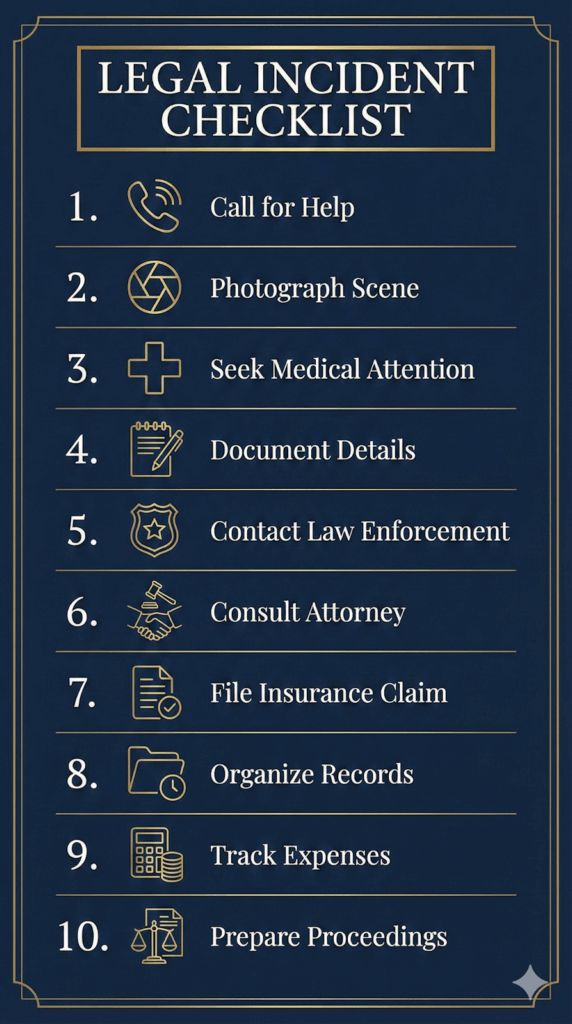
Step 1: Stop Your Vehicle and Check for Injuries
Alabama law requires all drivers involved in an accident to stop immediately. Leaving the scene of an accident involving injury or death is a Class C felony under Alabama Code § 32-10-1, punishable by one to ten years in prison and fines up to $15,000.
Check yourself and your passengers for injuries. If anyone is hurt, call 911 immediately. Do not attempt to move seriously injured people unless they are in immediate danger, such as from fire or an oncoming vehicle.
Step 2: Call 911 and Report the Accident
Alabama Code mandates that drivers immediately report any accident involving personal injuries or death. Even if injuries appear minor, call 911. There are two critical reasons for this.
First, a police report creates an official record of the accident that documents the scene, identifies witnesses, and often includes the officer’s preliminary assessment of fault. This document becomes key evidence in your injury claim.
Second, many injuries — including concussions, internal bleeding, whiplash, and soft tissue damage — do not present symptoms immediately. Adrenaline masks pain. Having a police report that documents you were in an accident protects you even if symptoms appear days later.
Alabama law also requires you to file a written accident report with the Alabama Law Enforcement Agency (ALEA) within 30 days if the accident involves injury, death, or property damage exceeding $500 (Form SR-13). Failure to report a property damage accident is a Class A misdemeanor. Failure to report an injury or death accident is a Class C felony.
Step 3: Document Everything at the Scene
Your phone is your most important tool at the accident scene. Use it to document everything:
- Photograph the vehicles from every angle — front, back, sides, and close-ups of all damage
- Photograph the road — skid marks, debris, road conditions, traffic signals, and signage
- Photograph your injuries — visible cuts, bruises, swelling, and any blood
- Record a video walking through the entire scene, narrating what you see
- Capture the other driver’s license plate, insurance card, and driver’s license
- Note the weather and lighting conditions — rain, fog, darkness, sun glare
- Record the time of the accident
This evidence can disappear within hours. Skid marks fade. Debris is cleared. Traffic patterns change. The more you document at the scene, the stronger your case becomes.
Step 4: Exchange Information — But Watch What You Say
Alabama law requires you to exchange contact and insurance information with the other driver. Collect the following:
- Full name and contact information
- Driver’s license number and state
- Insurance company name and policy number
- Vehicle make, model, color, and license plate number
- Names and badge numbers of responding officers
What NOT to say:
This is where Alabama’s contributory negligence rule creates a trap. Anything you say at the scene can be used to argue you were partially at fault. Avoid these phrases:
- “I’m sorry.” An apology can be interpreted as an admission of fault, even if you were just being polite.
- “I didn’t see you.” This suggests you were not paying attention — a form of negligence.
- “I think I might have been going a little fast.” Even an estimate can be used to assign partial fault.
- “I’m fine” or “I’m not hurt.” You may not know the extent of your injuries yet. This statement can be used later to argue your injuries are not related to the accident.
- “It was my fault” or “I should have…” Never admit fault in any form. Let investigators determine responsibility.
Keep your statements factual and brief. “There was a collision at this intersection” is safe. “I didn’t see the light change” is not.
Step 5: Identify and Talk to Witnesses
Witnesses are often the difference between winning and losing an Alabama personal injury claim. Their testimony can establish that the other driver was entirely at fault — which, in a contributory negligence state, is exactly what you need.
Before witnesses leave the scene:
- Get their full name and phone number
- Ask if they would be willing to provide a statement
- If possible, record a brief video statement on your phone while details are fresh
Witnesses forget details quickly. Within a week, memories begin to blur. Within a month, critical specifics may be lost entirely.
Step 6: Get Medical Attention Within 24 Hours
Even if you walked away from the crash feeling fine, see a doctor within 24 hours. This is not optional — it is essential for both your health and your legal claim.
Many serious injuries have delayed symptoms:
- Concussions and traumatic brain injuries may not show symptoms for hours or days
- Whiplash and soft tissue injuries often worsen 24–72 hours after impact
- Internal bleeding can be asymptomatic initially but become life-threatening
- Herniated discs may not cause noticeable pain until swelling develops
Tell your doctor exactly how the accident happened and describe all pain, discomfort, and limitations — even minor ones. This medical record creates the official link between the accident and your injuries. Without it, insurance companies will argue your injuries were pre-existing or caused by something else.
Keep every receipt related to your treatment: hospital bills, prescriptions, co-pays, parking at medical facilities, medical equipment, and mileage to appointments. These are all recoverable damages.
Step 7: Do NOT Give a Recorded Statement to the Insurance Company
This is the single most important piece of advice in this entire checklist.
Within days of your accident, you will likely receive a call from the at-fault driver’s insurance company. The adjuster will sound friendly and concerned. They will ask you to “describe what happened in your own words” and may request a recorded statement.
Do not do it.
Insurance adjusters are trained professionals whose job is to minimize what the company pays out. In Alabama, they know that establishing even 1% of fault on your part means paying nothing. Every question they ask is designed to get you to say something that can be twisted into a contributory negligence defense.
Common traps include:
- “Can you walk me through exactly what happened?” — They are looking for inconsistencies or admissions
- “Were you on your phone at the time?” — Even saying “I glanced at it” can be used against you
- “How fast were you going?” — Any estimate above the speed limit becomes evidence of negligence
- “Have you ever been in an accident before?” — They are building a case that your injuries are pre-existing
You are not legally required to give a recorded statement to the other driver’s insurance company. Politely decline and say: “I am represented by an attorney. Please direct all communications to my lawyer.”
Michael Strickland, founding partner of Strickland Law Group, has seen this tactic destroy otherwise strong cases throughout his 30+ years of practice. “The insurance company is not your friend. Their job is to pay you as little as possible — or nothing at all. Never give them the ammunition to do it.”
Step 8: Do NOT Post About the Accident on Social Media
Insurance companies actively monitor Facebook, Instagram, TikTok, X, and other platforms. They look for anything they can use to undermine your claim.
Posted a photo at a family gathering? They will argue you are not as injured as you claim. Checked in at a gym or park? They will say your injuries do not limit your activities. Wrote “feeling blessed” or “could have been worse”? They will use it to minimize your pain and suffering.
The safest approach: do not post anything about the accident, your injuries, your activities, or your legal case until your claim is fully resolved. Adjust your privacy settings and ask friends and family not to tag you in posts.
Step 9: Understand Alabama’s Key Deadlines
Alabama law imposes strict deadlines that can end your case before it starts:
- Accident report: File with ALEA within 30 days if the accident involves injury, death, or property damage over $500
- Statute of limitations: You have two years from the date of injury to file a personal injury lawsuit under Alabama Code § 6-2-38. For wrongful death, the two-year clock starts from the date of death.
- Insurance claim deadlines: Alabama insurers must acknowledge claims within 15 days and decide on claims within 30 days of receiving proof of loss
Missing the two-year statute of limitations is an absolute bar to recovery. The court will dismiss your case regardless of how severe your injuries are or how clearly the other driver was at fault.
Step 10: Contact an Experienced Alabama Personal Injury Attorney
In a contributory negligence state, handling your own claim is extremely risky. Insurance companies know that unrepresented claimants are far more likely to make statements that can be used to establish partial fault — and in Alabama, partial fault means zero recovery.
An experienced attorney will:
- Take over all communication with insurance companies immediately
- Preserve and collect evidence before it disappears
- Investigate the accident with reconstruction experts if needed
- Calculate the full value of your damages, including future medical costs
- Negotiate aggressively with insurers who know the firm is prepared for trial
- File a lawsuit within the statute of limitations if a fair settlement cannot be reached
Strickland Law Group has been representing Alabama injury victims since 1994. Our attorneys have recovered over $1 billion in settlements and jury verdicts, and founding partner Michael Strickland has personally tried more than 100 cases to verdict. We offer free consultations 24 hours a day, 7 days a week — and you never pay a fee unless we win your case.
Call 334-269-3230 or visit jurytrial.us/contact-us/ to speak with our team.
What About Alabama’s New Hands-Free Law?
Since June 2024, Alabama law makes it illegal to hold a cell phone while driving. Under SB 301, drivers face fines starting at $50, points on their license, and a Class C misdemeanor charge. The law was passed in memory of three Alabamians — Leah Grace Tarvin, CiCi Lunsford, and Jay Kendall — whose deaths were linked to distracted driving.
For accident victims, this law is a powerful tool. If the driver who hit you was holding a phone at the time of the crash, a citation under the hands-free law is direct evidence of negligence. This makes it significantly easier to establish fault — which is the essential requirement for recovery in Alabama’s contributory negligence system.
For a detailed breakdown of how this law affects your injury claim, read our full article: New Alabama Hands-Free Law and Accident Claims.
Special Considerations for Truck Accidents
If your accident involves a commercial truck, the stakes and complexity increase significantly. Trucking companies and their insurers deploy rapid response teams to accident scenes — sometimes within hours — to collect evidence, photograph the scene, and talk to witnesses before you have even consulted an attorney.
Critical evidence in truck accident cases includes electronic logging device (ELD) data, driver qualification files, maintenance records, and black box data from the truck’s event data recorder. Much of this evidence can be destroyed or overwritten within days if not formally preserved through a spoliation letter from your attorney.
Alabama’s contributory negligence rule applies to auto accidents of all types, but truck accident cases often involve multiple liable parties — the driver, the trucking company, the cargo loader, and the vehicle manufacturer — which creates additional opportunities for recovery.
Conclusion
With over 140,000 crashes on Alabama roads every year, the question is not whether you will be in an accident — it is whether you will be prepared when it happens. Alabama’s pure contributory negligence rule means that what you say, what you document, and who you talk to in the first 48 hours will determine whether you recover fair compensation or walk away with nothing.
Follow this 10-step checklist. Do not apologize at the scene. Do not give recorded statements to insurance. Do not post on social media. And contact an experienced Alabama personal injury attorney before the evidence disappears and the deadlines close.
Strickland Law Group is available 24/7 at 334-269-3230. The consultation is free. You pay nothing unless we win.
FAQ
Q: What should I do immediately after a car accident in Alabama?
A: Stop your vehicle, check for injuries, call 911, document the scene with photos and video, exchange information with the other driver, and get medical attention within 24 hours — even if you feel fine.
Q: Should I give a recorded statement to the other driver’s insurance company?
A: No. You are not legally required to give a recorded statement to the at-fault driver’s insurer. Adjusters use these statements to find evidence of contributory negligence. Let your attorney handle all communication.
Q: How long do I have to file a personal injury claim in Alabama?
A: Alabama Code § 6-2-38 gives you two years from the date of injury to file a lawsuit. For wrongful death, the deadline is two years from the date of death. Missing this deadline permanently bars your claim.
Q: Can I still recover compensation if I was partially at fault in Alabama?
A: Alabama’s pure contributory negligence rule bars recovery if you bear any fault — even 1%. However, exceptions exist for wanton conduct, last clear chance, children under 14, and certain product liability claims.
Q: Is it illegal to hold my phone while driving in Alabama?
A: Yes. Since June 2024, Alabama’s hands-free law (SB 301) makes it illegal to hold a wireless device while driving. Fines range from $50 to $150 with escalating points on your license. A citation under this law is evidence of negligence in an accident claim.
SOCIAL MEDIA COPY
- 140,000+ crashes hit Alabama roads in 2024. These 10 steps could save your injury claim — and your future. (109 chars)
- Did you know saying “I’m sorry” at a crash scene could cost you everything in Alabama? Here’s what to say instead. (116 chars)
- Alabama’s 1% fault rule means one wrong statement kills your case. Get the free accident checklist now. (104 chars)
This article references publicly available information from the Alabama Department of Transportation (ALDOT), Drive Safe Alabama, the Alabama Law Enforcement Agency (ALEA), FindLaw, and Strickland Law Group, including official crash data reports, Alabama Code provisions, and published legal analyses dated 2023–2026. All statistics and legal principles described reflect Alabama law as of February 2026. Results in personal injury cases depend on specific facts, evidence, and applicable law. This article is for informational purposes only and does not constitute legal advice. For guidance on your specific situation, contact Strickland Law Group at 334-269-3230 for a free consultation.