
A drunk driver runs a red light and crashes into a cyclist who is riding without a headlight. The driver is 99% at fault. The cyclist is 1% at fault. In 45 states, that cyclist still collects compensation. In Alabama, that cyclist gets nothing. Alabama is one of only five jurisdictions in the entire country that follows the pure contributory negligence doctrine — a rule that completely bars injured people from any recovery if they share even a sliver of fault. This article explains exactly how this rule works, why insurance companies weaponize it, and the five legal exceptions that may still protect your claim.
What Is Contributory Negligence? The Rule That Makes Alabama Different
Contributory negligence is a legal doctrine rooted in 19th-century English common law. The core principle is simple and severe: if you contributed to your own injury in any way — even by 1% — you are barred from recovering any compensation from the other party.
Under Alabama Rule of Civil Procedure 8(c), contributory negligence is listed as an affirmative defense. That means the defendant (or more often, their insurance company) bears the burden of raising and proving it. In practice, however, insurance adjusters raise contributory negligence in nearly every Alabama personal injury claim, regardless of how minimal the alleged fault may be.
The Alabama Supreme Court has repeatedly upheld the doctrine, ruling that contributory negligence is a complete defense to any action based on negligence. This precedent applies across case types — auto accidents, slip and fall injuries, medical malpractice claims, and wrongful death cases.
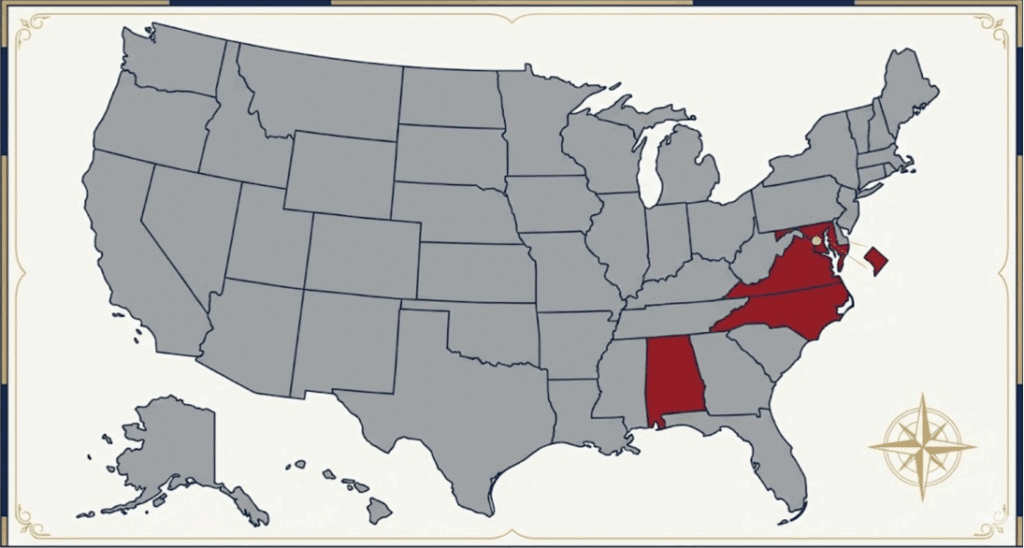
According to Justia’s 50-State Negligence Survey, only four states and the District of Columbia still follow the pure contributory negligence model: Alabama, Maryland, North Carolina, Virginia, and Washington, D.C. Every other state has adopted some form of comparative negligence, which reduces — rather than eliminates — a plaintiff’s recovery based on their share of fault.
Strickland Law Group is licensed in three of these five contributory negligence jurisdictions — Alabama, Washington D.C., and North Carolina — giving our attorneys direct experience navigating this strict legal landscape across state lines.
Why Insurance Companies Love This Rule — and How They Use It Against You
Insurance companies operating in Alabama understand that they only need to establish a fraction of fault to deny a claim entirely. This creates a powerful financial incentive to investigate every detail of an accident for anything that could shift even 1% of blame to the injured party.
Here is what that looks like in practice. After a car accident, an insurance adjuster contacts you and asks you to give a recorded statement. During the call, you mention that you “might have been going a little fast” or that you “didn’t see them until the last second.” Those offhand comments become the foundation of a contributory negligence defense.
Common tactics insurance adjusters use to establish partial fault include:
- Highlighting minor traffic violations — going 3 mph over the speed limit, failing to use a turn signal, or rolling through a stop sign
- Claiming the plaintiff was distracted — looking at a phone, talking to a passenger, or adjusting the radio
- Arguing the plaintiff failed to mitigate the hazard — such as not wearing a seatbelt, not using a crosswalk, or not slowing down in bad weather
- Using your own social media posts against you — photos or check-ins that contradict your stated injuries or activities
Michael Strickland, founding partner of Strickland Law Group, has tried over 100 cases in his career since 1994 and has seen this playbook from insurance companies countless times. “Insurance adjusters are trained to find any opening,” Strickland notes. “In Alabama, they know that even a tiny crack in the plaintiff’s story can be enough to deny an entire claim. That’s why what you say — and don’t say — in the first 48 hours after an accident matters enormously.”
This is precisely why personal injury attorneys in Alabama take over all communication with insurance companies immediately. A single unguarded statement can undermine a case worth hundreds of thousands of dollars.
Contributory Negligence vs. Comparative Negligence: What Alabama Accident Victims Lose

To understand how severe Alabama’s rule is, consider a real-world scenario.
A driver suffers $200,000 in damages — medical bills, lost wages, pain and suffering — when another driver runs a red light and hits their vehicle. However, investigators determine the injured driver was traveling 5 mph over the speed limit, assigning them 10% of the fault.
Here is what happens in different states:
In a pure comparative negligence state (like California or New York): The injured driver recovers $180,000 — their full damages reduced by their 10% fault.
In a modified comparative negligence state (like Texas or Ohio): The injured driver still recovers $180,000, because their fault is well below the 50% or 51% threshold that would bar recovery.
In Alabama: The injured driver recovers $0. Ten percent fault. Zero compensation.
This is the reality for accident victims in Alabama. The gap between what injured Alabamians can recover and what victims in virtually every other state receive is enormous — and it is a gap that insurance companies exploit every day.
The harsh consequence of this rule is why Strickland Law Group invests heavily in immediate, thorough investigation of every accident. Our attorneys work with accident reconstruction specialists, obtain dashcam and surveillance footage before it is overwritten, and secure witness statements within days — not weeks — to build cases that shut down contributory negligence arguments before they gain traction.
The 5 Exceptions That May Save Your Alabama Injury Claim
Despite its severity, Alabama law does recognize several important exceptions to the contributory negligence doctrine. If your case falls within one of these categories, you may still recover full compensation even if you were partially at fault.

Exception 1: The “Last Clear Chance” Doctrine
If the defendant had the final opportunity to prevent the accident but failed to act, the plaintiff may still recover compensation — even if the plaintiff was partially negligent.
Example: A pedestrian crosses the street carelessly, but a driver sees them with plenty of time to stop and fails to brake. Under the last clear chance doctrine, the driver may still be held liable because they had the last opportunity to avoid the collision.
Alabama courts have applied this doctrine in cases where the evidence clearly shows the defendant could have taken reasonable action to avoid the harm. It effectively shifts the focus from the plaintiff’s initial negligence to the defendant’s failure to act when they had the chance.
Exception 2: Wanton or Willful Misconduct
Contributory negligence is not a defense when the defendant acted with wantonness — defined as a conscious disregard for the known safety and rights of others. This is a higher standard than ordinary negligence and requires showing that the defendant knew their behavior was dangerous and proceeded anyway.
Example: A drunk driver with a blood alcohol level well above Alabama’s legal limit runs a red light and strikes another vehicle. Even if the injured driver was slightly speeding, the drunk driver’s wanton conduct may override the contributory negligence defense.
Under this exception, plaintiffs may recover both compensatory and punitive damages. Punitive damages are specifically designed to punish egregious behavior and deter similar conduct in the future.
Exception 3: Children Under 14
Alabama law provides strong protections for minors. Children under the age of 7 are legally incapable of contributory negligence under any circumstances. Children between the ages of 7 and 14 are presumed incapable of contributory negligence, though this presumption can be rebutted by the defendant.
This exception recognizes that children lack the cognitive development and life experience to fully appreciate risks the way adults do. It prevents defendants from shifting blame onto young accident victims.
Exception 4: Individuals with Mental Incapacity
Persons who are mentally challenged or legally incompetent may be deemed incapable of contributory negligence. The rationale is similar to the protection for children — individuals who cannot reasonably understand risks should not be penalized for failing to avoid them.
Proving mental incapacity as an exception can be complex and typically requires medical documentation and expert testimony. An experienced attorney can evaluate whether this exception applies to your situation.
Exception 5: Product Liability Cases (AEMLD)
Alabama has adopted a form of strict liability for defective products under the Alabama Extended Manufacturer’s Liability Doctrine (AEMLD). In many product liability cases, contributory negligence does not apply in the same way as it does in standard negligence claims.
When a manufacturer places a defective product into the stream of commerce and that product causes injury, the focus shifts to the product itself — not the plaintiff’s conduct. This is a critical distinction for cases involving defective vehicles, medical devices, machinery, and consumer products.
What to Do Right Now If You Have Been Injured in Alabama
Given Alabama’s strict contributory negligence rule, the steps you take immediately after an accident can make or break your case. Here is what Strickland Law Group advises based on over 30 years of trial experience:
Do not give a recorded statement to any insurance company. Adjusters will use your own words to build a contributory negligence defense. Let your attorney handle all communication.
Document everything at the scene. Photograph the accident from every angle. Capture road conditions, traffic signals, vehicle damage, and any visible injuries. Use your phone to record a brief video of the entire scene if possible.
Get medical attention within 24 hours — even if you feel fine. Adrenaline masks pain. Injuries like soft tissue damage and concussions often do not present symptoms immediately. Without a medical record linking your injuries to the accident, insurance companies will argue your injuries came from something else.
Do not post about the accident on social media. Insurance investigators monitor Facebook, Instagram, and other platforms. A photo of you at a family event can be used to argue that your injuries are not as severe as claimed.
Contact an attorney before speaking to anyone else about the accident. In a contributory negligence state, legal representation is not optional — it is the difference between recovering compensation and walking away with nothing.
Strickland Law Group offers free consultations 24 hours a day, 7 days a week. Our attorneys are licensed in Alabama, Georgia, Vermont, Colorado, North Carolina, and Washington D.C. — and we can assist clients in all 50 states. Call 334-269-3230 to speak with our team immediately.
Conclusion
The cyclist who was 1% at fault and received nothing — that is not a hypothetical. That is how Alabama law works today, and it is how insurance companies deny valid claims every day in this state. But contributory negligence is not an absolute death sentence for your case. The last clear chance doctrine, the wanton conduct exception, protections for children and individuals with mental incapacity, and the AEMLD framework for product liability all provide real pathways to full recovery.
Since 1994, Strickland Law Group has recovered over $1 billion in settlements and jury verdicts for clients across the country. Michael Strickland has personally tried more than 100 cases and understands exactly how to counter the insurance industry’s contributory negligence playbook in Alabama courtrooms.
If you have been injured in an accident and are worried that partial fault could cost you everything, do not wait. Call Strickland Law Group at 334-269-3230 for a free, no-obligation consultation. We do not charge a fee unless we win your case.
FAQ
Q: Can I recover any compensation in Alabama if I was partially at fault for my accident?
A: Generally, no. Alabama’s pure contributory negligence rule bars recovery if you share any fault. However, exceptions like wanton conduct, last clear chance, and protections for minors may apply. An attorney can evaluate your situation.
Q: How many states still use the contributory negligence rule?
A: Only five jurisdictions — Alabama, Maryland, North Carolina, Virginia, and Washington D.C. All other states use some form of comparative negligence that allows partial recovery.
Q: What is the difference between contributory negligence and comparative negligence?
A: Contributory negligence bars all recovery if you are even 1% at fault. Comparative negligence reduces your recovery proportionally — so 10% fault means you still receive 90% of your damages.
Q: Can insurance companies use contributory negligence to deny my Alabama car accident claim?
A: Yes. Insurance adjusters routinely raise contributory negligence as a defense. They look for minor violations — slight speeding, failure to signal — to assign partial fault and deny the entire claim.
Q: Does contributory negligence apply to product liability cases in Alabama?
A: Often, no. Alabama’s Extended Manufacturer’s Liability Doctrine (AEMLD) applies strict liability principles to defective product cases, which can override the contributory negligence defense.
This article references publicly available information from the Alabama Judicial System, Justia, LawInfo, and Strickland Law Group, including official documentation, court rules, and published legal analyses dated 2023–2026. All legal principles described reflect Alabama law as of February 2026. Contributory negligence outcomes depend on specific case facts, evidence, and applicable exceptions. This article is for informational purposes only and does not constitute legal advice. For guidance on your specific situation, contact Strickland Law Group at 334-269-3230 for a free consultation.